How to Choose the Right Grinding Mill for Aluminum Hydroxide Powder Production
Introduction
The production of high-quality aluminum hydroxide (Al(OH)₃) powder is a critical process in industries ranging from flame retardants and ceramics to pharmaceuticals and fillers for polymers. The performance of the final product is heavily dependent on its particle size distribution, morphology, and purity. Selecting the appropriate grinding mill is therefore not merely an equipment choice but a strategic decision impacting product quality, operational efficiency, and overall profitability. This guide provides a comprehensive framework for evaluating and selecting the optimal grinding solution for your aluminum hydroxide powder production line.
Key Properties of Aluminum Hydroxide and Grinding Challenges
Aluminum hydroxide, or alumina trihydrate (ATH), presents specific challenges during size reduction:
- Moderate Hardness: With a Mohs hardness of approximately 2.5-3.5, it is softer than many minerals but can still cause abrasion over time.
- Thermal Sensitivity: ATH begins to decompose and lose its bound water (calcine) at temperatures above 180-200°C. Excessive heat generated during grinding can alter its chemical structure, reducing its effectiveness as a flame retardant.
- Particle Morphology: For many applications, maintaining or achieving a specific particle shape (e.g., platy for reinforcement) is as important as achieving a fine size.
- Chemical Purity: The grinding process must not introduce contaminants that could affect the powder’s whiteness or reactivity.
These characteristics necessitate a mill that offers precise temperature control, minimal contamination, and flexible particle size control.
Critical Selection Criteria for Grinding Mills
1. Target Particle Size and Distribution
This is the primary driver. Aluminum hydroxide powders are used across a wide spectrum of fineness:
– Coarse Grades (45-200 mesh / 350-75 μm): Often used as fillers in plastics and rubber.
– Medium-Fine Grades (200-800 mesh / 75-18 μm): Common for flame retardant applications.
– Superfine & Ultrafine Grades (800-2500+ mesh / 18-5 μm and below): Required for high-performance ceramics, electronic substrates, and specialty composites where surface area and reactivity are crucial.
The mill must reliably and consistently achieve your target D50 and D97 values with a narrow size distribution.
2. Production Capacity (Throughput)
Match the mill’s hourly throughput with your plant’s required annual output, considering operational hours. Under-sizing leads to bottlenecks, while over-sizing increases capital and operating costs unnecessarily.
3. Grinding Mechanism and Heat Generation
The method of comminution directly impacts product quality:
– Impact/Crush (e.g., Hammer Mills): High throughput for preliminary size reduction but limited fineness control and higher heat generation.
– Compression/Roll (e.g., Vertical Roller Mills, Trapezium Mills): Efficient, lower-temperature grinding suitable for medium to fine powders.
– Shear/Attrition (e.g., Ball Mills, Ultrafine Mills): Excellent for achieving very fine and uniform powders. Modern designs incorporate efficient cooling systems.

4. Energy Efficiency and Operating Costs
Grinding is an energy-intensive process. Evaluate the specific energy consumption (kWh/ton) of different mill types. Modern, integrated mill-classifier systems often offer significant savings over traditional ball mill circuits.
5. System Integration and Footprint
Consider the complete system: feeding, grinding, classification, collection (cyclone & bag filter), and packaging. A compact, vertically integrated system reduces plant footprint, installation complexity, and material handling points.
6. Ease of Maintenance and Wear Part Life
Aluminum hydroxide, while not extremely hard, is abrasive. Mills with easily replaceable wear parts (rollers, rings, liners) made from specialized alloys dramatically reduce downtime and long-term operating costs.
7. Environmental and Safety Compliance
The system must operate under negative pressure with high-efficiency dust collection (e.g., pulse-jet bag filters) to ensure a clean working environment and meet emission standards. Noise levels should also be within regulatory limits.
Analysis of Common Mill Types for Aluminum Hydroxide
Ball Mill
Overview: A workhorse for general mineral grinding.
Pros: High capacity, reliable, can produce fine powders.
Cons for ATH: High energy consumption, significant heat generation (requires cooling), potential for over-grinding, broad particle size distribution unless coupled with an external classifier, large footprint.
Best For: High-volume production of medium-fine ATH where thermal degradation is less critical.
Raymond Mill (Pendulum Roller Mill) / MTW Series Trapezium Mill
Overview: A classic design using spring-loaded rollers against a rotating ring.
Pros: Stable operation, good for medium-fine grinding (30-325 mesh), lower capital cost than some advanced mills.
Cons for ATH: Fineness ceiling (typically ~325 mesh/45μm), grinding pressure may be limited, older designs may have lower energy efficiency.
Best For: Cost-effective production of standard flame-retardant grade ATH powders.

Vertical Roller Mill (VRM) / LM Series
Overview: Uses hydraulically loaded rollers to compress and grind material on a rotating table.
Pros: Excellent energy efficiency, integrated drying/grinding/classification, low heat generation due to large air volume, capable of medium to relatively fine grinding (80-600 mesh).
Cons for ATH: May have a fineness limit for the very finest ultrafine grades (<5μm).
Best For: Large-scale production of fine ATH powders with excellent energy economy and system integration.
Ultrafine Grinding Mill / SCM Series & LUM Series
Overview: The state-of-the-art for producing superfine and ultrafine powders. These mills combine high-pressure grinding rollers with highly precise, often multi-stage, turbo classifiers.
Pros: Unmatched ability to produce fine (325-2500 mesh/5-45μm) and uniform powders with narrow distribution. High grinding efficiency relative to other fine-grinding methods. Advanced models feature excellent temperature control through large airflows and sometimes external cooling systems.
Cons for ATH: Higher initial investment. Requires careful system engineering.
Best For: This is the premier choice for high-value, ultrafine aluminum hydroxide powders. It directly addresses the key challenges of heat control and precise top-size cut.
Recommended Solution for Ultrafine Aluminum Hydroxide Powder
For producers targeting the high-end market with ultrafine (D97 ≤ 5μm) and narrowly distributed aluminum hydroxide powder, the SCM Ultrafine Mill represents an optimal technological solution.
Its design philosophy directly counteracts the challenges of grinding ATH:
- Precision & Purity: The integrated vertical turbo-classifier provides an extremely sharp cut point, ensuring no coarse particles contaminate the final product. The grinding elements can be lined with specialized materials to prevent iron contamination.
- Thermal Management: The large volume of air drawn through the mill acts as an effective coolant, keeping the product temperature well below ATH’s decomposition point. The grinding principle itself generates less heat than impact-based methods.
- Efficiency: With a claimed energy consumption up to 30% lower than traditional jet mills for similar products, it offers significant operational savings for ultrafine production.
- Robustness: The wear-resistant design of the roller and ring assembly ensures consistent performance and long service intervals, critical for abrasive materials.
- Environmental Control: The system operates under full negative pressure with a high-efficiency pulse jet baghouse, guaranteeing dust-free operation and emissions compliance.
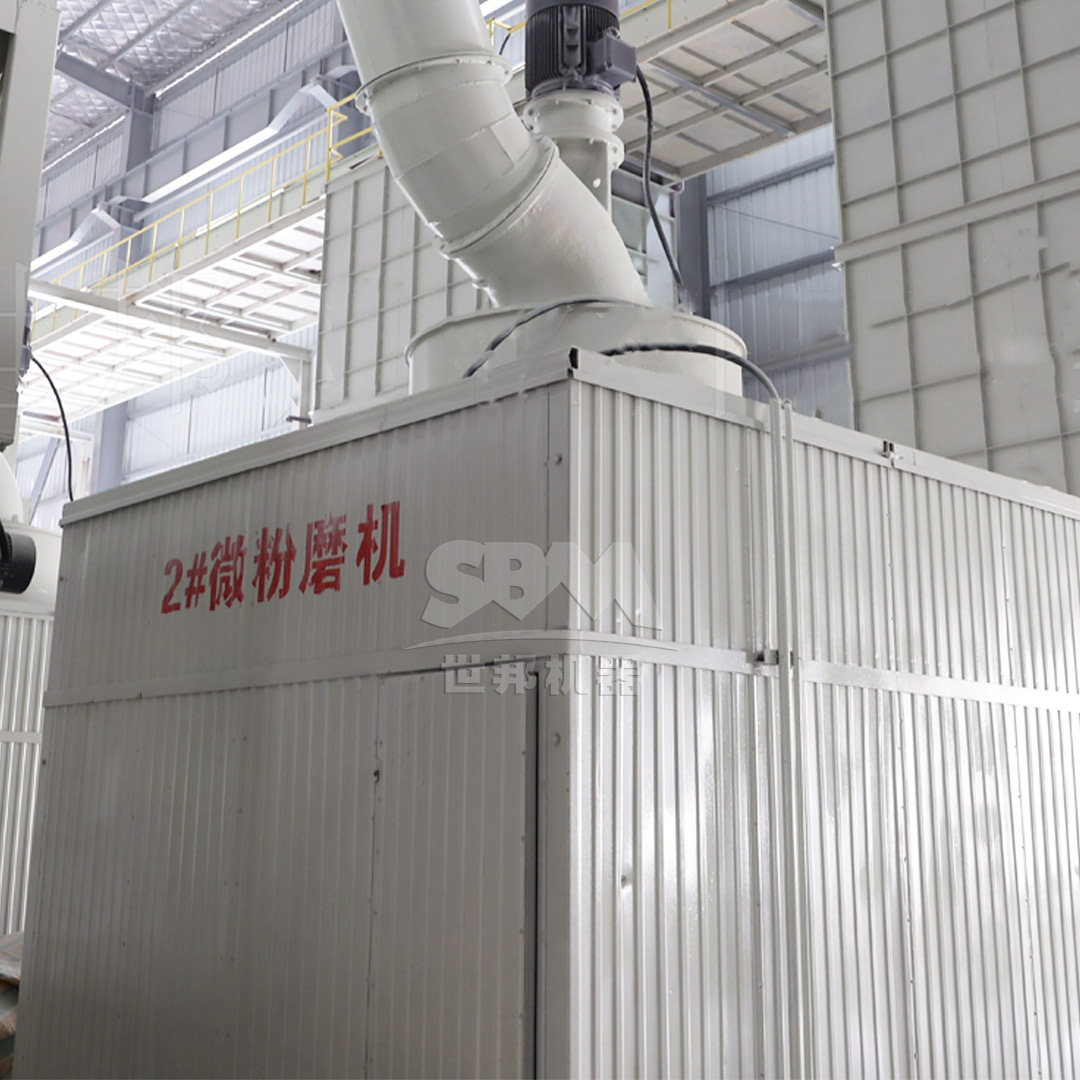
Model Selection Example: For a plant requiring an output of 2-4 tons per hour of ultrafine ATH powder (D97 ≤ 5μm), the SCM800 model, with a 75kW main motor and a capacity range of 0.5-4.5 t/h, would be a suitable and efficient choice. For larger scale production, the SCM1250 or SCM1680 models offer capacities up to 14 and 25 t/h respectively.
Secondary Recommendation for Medium-Fine Production
For operations focused on high-volume production of fine (e.g., 200-400 mesh) aluminum hydroxide for mainstream flame retardant applications, the MTW Series Trapezium Mill offers an outstanding balance of performance, reliability, and cost. Its curved air duct and conical gear transmission improve energy efficiency over older Raymond mill designs. The wear-resistant shovel and roller design reduces maintenance costs. A model like the MTW175G, with a capacity of 9.5-25 t/h, is ideal for large-scale, cost-sensitive production lines where the ultimate in ultrafineness is not required.
Conclusion
Selecting the right grinding mill for aluminum hydroxide is a multi-faceted decision. Begin by rigorously defining your product specifications (fineness, distribution, morphology) and capacity needs. Evaluate mills not just as standalone units but as complete systems encompassing feeding, classification, and collection. For standard fine powders, modern trapezium mills like the MTW Series provide robust and efficient solutions. However, for the growing market of ultrafine, high-performance aluminum hydroxide powders, advanced ultrafine grinding technologies like the SCM Ultrafine Mill are indispensable. Its ability to deliver precise, low-temperature, energy-efficient grinding makes it the benchmark technology for producers aiming at the premium end of the market. Investing in the correct grinding technology from the outset ensures product quality, operational efficiency, and long-term competitiveness.